
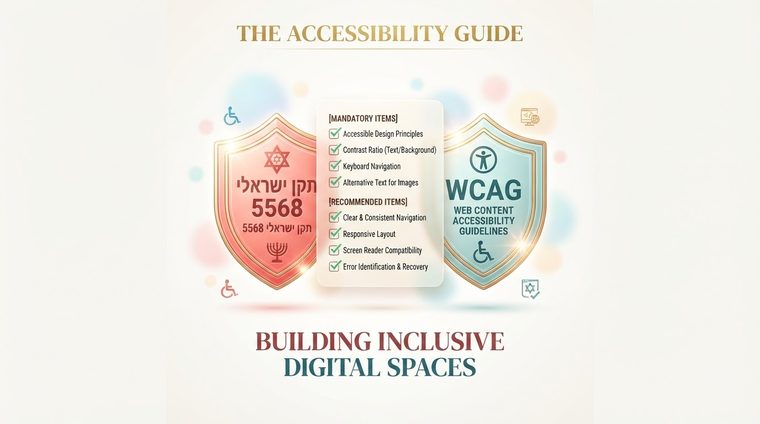
"We already comply with WCAG" and "our site complies with Standard 5568" sound like the same statement — but they’re not exactly identical, and the difference matters when it comes to compliance with Israeli law. In this article, we’ll explain how the two standards connect, what’s legally mandatory, and what goes beyond the requirement but is still highly recommended.
In short — what this guide covers
How 5568 and WCAG connect
WCAG (Web Content Accessibility Guidelines) is an international standard published by the W3C that defines technical criteria for digital content accessibility. SI 5568 is the Israeli standard, which adopts WCAG’s principles and guidelines and adapts them to the local regulatory framework — it’s the standard that Israeli regulations actually point to in order to define what "accessibility" means legally.
WCAG is built around four principles sometimes called POUR: Perceivable — content that can be sensed in some way, Operable — an interface that can be operated even without a mouse, Understandable — content and interface that are predictable and clear, and Robust — compatibility with assistive technologies like screen readers.
What’s mandatory: level AA
Of the three compliance levels WCAG defines (A, AA, and AAA), level AA is the mandatory threshold under Israeli regulation for most bodies — public and private alike. It’s the level actually tested when checking compliance with the standard, and it’s the level our tool checks against by default.
There’s relief available for very small businesses: businesses with an especially low revenue turnover can request a partial exemption that lowers the requirement to level A only. The exact threshold for this exemption is updated from time to time, so we won’t cite a fixed figure here — it’s worth checking the current amount with the Commission for Equal Rights of Persons with Disabilities before relying on it.
What’s recommended: beyond the legal requirement
WCAG itself has been updated since the Israeli standard first adopted it: WCAG 2.1 (2018) added criteria relevant mainly to mobile and cognitive disabilities, and WCAG 2.2 (2023) added further requirements around interactive interfaces. Not all of these newer criteria have formally become mandatory under the current version of the Israeli standard — but they represent the direction regulation is heading, and building to them today saves expensive rework later.
Level AAA — the highest level in WCAG — is also not mandatory, but it’s worth adopting specific criteria from it (like higher contrast or simpler language) for critical content, such as forms or legal documents.
- Mandatory: compliance with level AA per the current version of SI 5568.
- Recommended: adopting WCAG 2.1/2.2 criteria that aren’t yet formally mandatory.
- Recommended for critical content: considering select AAA-level criteria.
How this applies to documents too
The exact same logic applies to digital documents — not just web pages. SI 5568 Part 2 applies WCAG’s principles to PDF, Word, and other document files: structure tags, hierarchical headings, alt text for images, and a logical reading order — exactly what screen readers need to "understand" a document. That’s why our tool checks the exact same criteria for documents too, not just for the website itself.
💡 Practical tip
Want to check basic compliance yourself? Start with the simple question: can you navigate the entire site (and every document) using only the keyboard, with no mouse at all? If not — that’s already a strong indication of a gap from level AA.
⚖️ Legal disclaimer
The information in this article is provided for general informational purposes only and does not constitute legal advice. It’s recommended to consult an attorney who specializes in accessibility and to check the current version of SI 5568 on the Standards Institution of Israel website.
Want to check exactly where your documents stand?
Our tool automatically checks every document against AA criteria, and shows you exactly where the gaps are.
Get a Free Check ←