
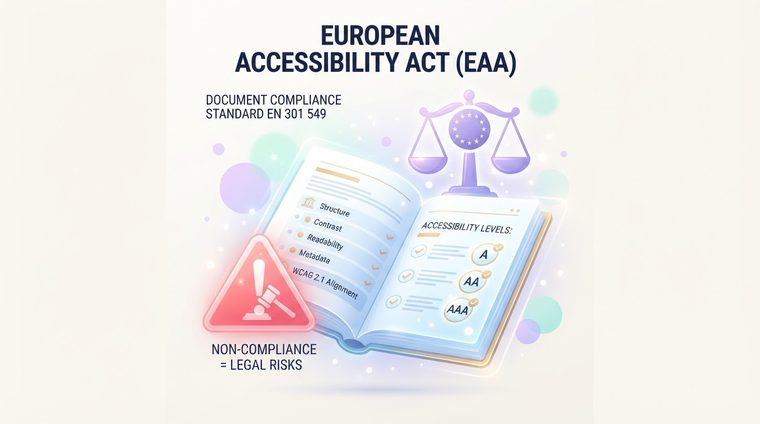
On June 28, 2025, the European Accessibility Act (EAA) came into full force — and enforcement has already begun in practice. If your company sells products or services to customers in Europe, even if your offices are in Israel, this article explains exactly what you need to know.
In short — what this article covers
What the EAA actually is
The European Accessibility Act (EU Directive 2019/882) is sweeping legislation that mandates digital accessibility across a wide range of products and services: e-commerce sites, online banking, communication services, transportation, e-books, and more. Unlike WCAG, which is a technical set of guidelines, the EAA is binding law with real penalties — fines, injunctions, and civil lawsuits.
Who it applies to
A critical point many companies miss: the law doesn’t apply only to companies headquartered in the EU. Any company offering digital products or services to customers in the European market is subject to its requirements — including Israeli companies with a site in a European language, an online store that ships to customers in Europe, or an app available in EU countries.
What’s already happening in Europe
This isn’t a theoretical threat — here’s what actually happened in the first six months of enforcement:
- France: four major retail chains — Auchan, Carrefour, E.Leclerc, and Picard — received formal notices in July 2025 over accessibility issues on their e-commerce sites, and after failing to fix them, faced expedited legal proceedings in November 2025. The DGCCRF government authority was the most active enforcer in practice.
- Sweden: the PTS authority received over 120 public complaints, most concerning e-commerce sites, and even began conducting real-world tests with screen reader software.
- Germany: law firms are sending cease-and-desist letters to e-commerce companies, treating accessibility failures as a violation of fair competition law.
💡 Important point
The pattern in every case is similar: not rare edge cases, but basic failures — missing alt text, low contrast, broken keyboard navigation. The exact same failures show up in the PDF documents that accompany these sites too.
What to do now
The first step is an honest picture of where you stand: test your site against the EN 301 549 standard (the official standard the EAA is based on — read our full guide), map which PDF documents on your site fail to meet the requirements, and build an organized, priority-ordered remediation plan — before someone does it for you through a formal complaint.
Want to know if the documents on your site are exposed under the EAA?
Our free tool scans every PDF file on your site and shows you exactly where the gaps are.
Scan Your Site for Free ←After the scan, you can also make the documents it flags accessible directly and for free through AccessiDoc.