
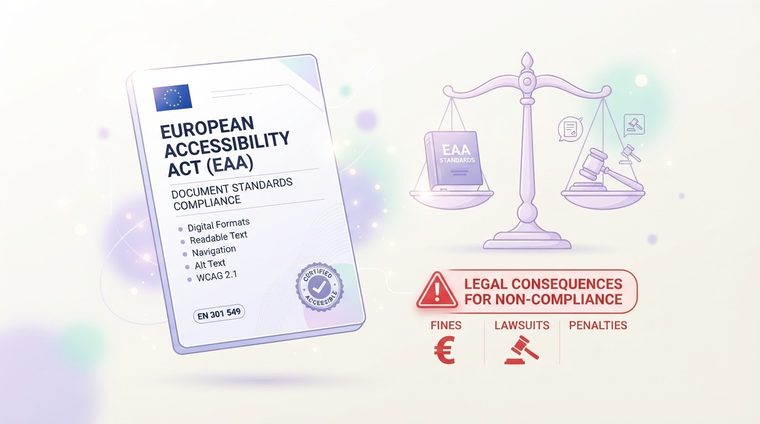
In Europe, "wait and see" is no longer an option when it comes to document accessibility. Since June 28, 2025, the European Accessibility Act (EAA) has been in full force, and countries like France and Sweden are already actively enforcing it — including lawsuits against major companies. This article explains who’s obligated, what the legal risk looks like, and what has actually happened over the past year.
In short — what this article covers
Who’s obligated to make documents accessible under the EAA
The EAA (EU Directive 2019/882) applies to a wide range of digital services: e-commerce, banking, communication services, transportation and telecommunications, as well as the documents that accompany them — terms and conditions, account statements, registration forms, and contracts. It’s important to understand: the law doesn’t apply only to companies headquartered in the EU — any company selling products or services to customers in Europe, including Israeli companies, is subject to the requirements if it has a digital presence aimed at the European market.
What actually happened: enforcement and lawsuits in Europe in 2025–2026
This isn’t a hypothetical scenario — enforcement has already begun, and at an accelerating pace:
- France — the first major lawsuit: in July 2025, accessibility organizations (Droit Pluriel, Intérêt à Agir, and ApiDV) sent formal notices to four major retail chains — Auchan, Carrefour, E.Leclerc, and Picard — over inaccessible e-commerce sites: missing alt text, poor contrast, broken link and heading structure, and no keyboard navigation. When improvements didn’t materialize, an urgent injunction request ("référé") was filed in November 2025. As of early 2026 the proceedings are still pending, with no final ruling — but the message to the market has already landed.
- France — the government regulator: France’s DGCCRF authority was the most active real-world enforcer, sending official notices to additional large retailers over issues in checkout flows, product browsing, and the absence of accessibility statements.
- Sweden: the PTS authority opened its first enforcement cases against e-commerce sites, receiving more than 120 public complaints — the vast majority concerning online retail services. The authority even began hands-on testing with screen reader software.
- Germany: enforcement there comes mainly from the private sector — law firms sending cease-and-desist letters to e-commerce companies, treating accessibility failures as a violation of fair competition law (Unfair Competition).
- Norway (outside the EU, but with parallel legislation): the HelsaMi health portal was hit with a cumulative daily fine of roughly 50,000 Norwegian kroner (about €4,500) over ongoing accessibility failures — a fine that keeps accruing as long as the issue remains unfixed.
💡 Important point
Notice the shared pattern across these complaints: these aren’t rare or especially technical problems — missing alt text, low contrast, and unclear links are the exact same defects that show up in PDF documents too. An organization whose documents suffer from the same issues is exposed to the same kind of complaint.
The legal consequences of non-compliance
The consequences span several levels: financial fines set at the national level by each member state (which can reach hundreds of thousands of euros for repeated violations), injunctions requiring fixes on a short timeline, and exposure to civil lawsuits from accessibility organizations or individual customers. Beyond that, there’s substantial reputational damage — as we saw in France, simply publicizing the names of companies being sued creates significant public pressure on its own.
What this actually means for your organization
If your company sells products or services to customers in Europe — even if your offices are in Israel — you should assume the exposure exists. The first step is an accurate picture: which documents and pages exist, and what their actual accessibility status is. From there, you can build an organized, priority-ordered remediation plan, instead of waiting for a cease-and-desist letter.
Want to know if your documents are exposed?
Our free tool scans every PDF file on your site and shows you exactly which documents fail to meet the requirements — before someone else checks that for you.
Scan Your Site for Free ←After the scan, you can also make the documents it flags accessible directly and for free through AccessiDoc.